Friday, 1 February 2013

OUGD401 Lecture Notes: Democratic Lecture.


"Design is not your job. Design is about people, your personality and the ability to make relationships work is a massive factor in your employability"


WHAT IS GRAPHIC DESIGN?


"Identify what your good at 
and what you want to do!"


It has become redundant and exists in a small proportion. 
There are two types of design - Logical and Emotional.

Designers that use logic
Utilise 

Clarify function
Rationalise
The communicative elements beyond any other means to present a formal and precise argument to their audience
Designers that use emotion
Use any and everyday form of communication available

Intelligence

BRAND SPANKING

"The deeper you dig the higher you rise
That's were your brand will come from"
It's ubiquitous + bullshit

Corporation is different to branding
The irritation is that branding is now a catch all term
Fed Ex : Consistency + repetition
AOL: As many logo's + dynamic
Context: What it means in the context you are trying to do


PORTFOLIO

"The portfolio is probably the most subjective piece
 of work you will ever design - not everyone's going to like it."

You can have the best portfolio but it is all down to the individual person
Simple portfolios work best
Don't over complicate it
Don't look at trends, be true to your work as it might come back to haunt you


PLACEMENTS

"Placements are a must. .
 it's all about experience!"

WHY YOU SHOULD 


    Agency insight


      New expectations


        Real work


          Hone all of you skills


            Build bridges ad meet some interesting folk


              Put you ahead of the competition


                Improve your tea making


                  Reassure you of your ability make you more confident

                  WHY YOU SHOULDN'T

                  Make a loss money - wise
                  Away for a period of time more often than not alone 
                  Taken advantage of

                  GETTING A PLACEMENT

                  Have a hit list 
                  Research everything
                  Show your work before you call
                  CV - Experience is the main thing
                  Talk to people who have been through the experience

                  WHAT TO DO WHEN YOU'RE THERE

                  Be punctual 
                  A little enthusiasm goes a long way
                  Be yourself 
                  Spell their fucking name right
                  Play the game . . your taking from them to give something back

                  Wednesday, 30 January 2013

                  OUGD401 Lecture Notes: Photography as Document


                  Jacob A. Riis "a growler gang in session" ( robbing a lush) 1887 - street Arabs, the lawless youth, rein-acted 

                  Lewis hine, Russian steel workers, homestead 1908 - sociological, never exploit, retains self, reports the conditions 

                  Duffer boy 1909 

                  F.S.A- farm security administration - migration, desperate for work 

                  Margaret Bourke-white "sharecroppers home" 1937 - temporary structure built for shelter, lined with newspaper, practical material, insulated, creative, not objective, Opposite of American dream 

                  Russell lee "interior of a black farmers house" 1939 - less artistic use of composition, meekly recording 

                  Dorothea Lange "migrant mother" 1936 
                  Hungry, desperate, no name or her history 
                  Iconic, classic mother n child sitch,

                  Walker Evans - floyd Burroughs (gerorge gudger) hale county 1936 - no editing or manipulation, real gritty poverty

                  Bill Brandt - Northumberland miners at his evening meal 1937 - northerner, working class

                  Robert frank 'parade - Hoboken, New Jersey' 1958 - contradict, othering not exploitative 

                  William Klein st Patrick's day, fifth avenue 1954 - 55 - his presents is akbowledged

                  Dance in Brooklyn 1955 - blur, dark connotation, captures movement of the city, grain and blur - redefine the tradition of documentary 

                  Magnum group - founded in 1947 by henri Cartier Bresson - unaware of presence , seamless photographer, surrealism, mystery 

                  The decisive moment - photography achieves its highest distinction - reflecting the universality of the human condition in a never-to-be moment

                  France 1932 pic , reflection in the water, sees the world as a stage, no manipulation, modernism, truth to the materials 

                  Documentary and war 
                  Robert capa "the falling soldier" 1935 - the moment of the soldiers death, claims its wasn't real,
                  Robert capa " Normandy, France" 1945 

                  George Rodger "Bergen - Belsen concentration camp" 1945 , horror, 

                  Lee miller 

                  Hung cong ut - attack 1972, anti war statement, iconic, viewers discuss, relation of the photographer to the subject, 

                  Robert haeberle "people about to be shot" 1969 - implicit shooting, desire to gather info, overrides human response 

                  Don McCullin "she'll shocked soldier" 1968 - trauma, retreats, idealised landscapes 

                  Vietnam - reffered to the war in colour

                  Documentary exhaustion Clarke 1997;163 

                  William niedich 1989 - documentary constructed, attempt to re-write American history, sydjugation of American Indians, 9 th cent processes 

                  Edward Curtis native north Americans (early 20th century) 

                  Rodger Korangi, Nuba tribesmen, 1940 

                  Bruno barbey - left wing riot protesting 1972, aesthetic over social impact 

                  Jeremy deller "the battle of orgreave" 2001 

                  Deller is both reserving the memory of political struggles which no longer have force in the culture - Nash 2006 

                  Wednesday, 23 January 2013

                  OUGD401 Lecture notes: Avante-garde Cinema

                  Avante-garde Cinema

                  • In opposition to main stream cinema 
                  • Non linear/ Non figurative/ Non narrative
                  • Require a different kind of spectatorship
                  • Hard to define, challenges and questions peoples understanding
                  • Radicalism- doesn't get shown because it doesn't appeal to general audience
                  • Outside capitalism

                  Un chien andalou (1929) Dir. Lius Bunuel


                  Un chien andalou is a 1929 silent surrealist short film by the Spanish director Luis Buñuel and artist Salvador Dalí. It was Buñuel's first film and was initially released in 1929 with a limited showing at Studio des Ursulines in Paris, but became popular and ran for eight months.The film has no plot in the conventional sense of the word. The chronology of the film is disjointed, jumping from the initial "once upon a time" to "eight years later" without the events or characters changing very much. It uses dream logic in narrative flow that can be described in terms of then-popular Freudian free association, presenting a series of tenuously related scenes.

                  The idea for the film began when Buñuel was working as an assistant director for Jean Epstein in France. Buñuel told Dalí at a restaurant one day about a dream in which a cloud sliced the moon in half "like a razor blade slicing through an eye". Dalí responded that he'd dreamed about a hand crawling with ants. Excitedly, Buñuel declared: "There's the film, let's go and make it.'" They were fascinated by what the psyche could create, and decided to write a script based on the concept of suppressed human emotions.

                  Massively influencial and the start of what radical cinema could become.
                  Still inspires and influences people to this day


                  Mathew Barney- Cremaster


                  The film project was 8 years in the making 1994-2002, it consists of 5 feature length films, accompanying sculptures, drawings and photographs. It alludes the process of sexual differentiation during the embryonic process. Filmed in the Guggenheim gallery.

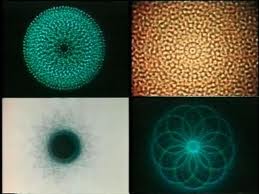
                  Oskar Fischinger- Spirals

                  Modernist
                  Hypnotic 
                  'in the process of seeing you become aware of seeing and the coordination between the eye and the brain'


                  James Whitney-Lapis 1966


                  tried to link speed of the film to brain waves. Romantic, with a mysticism about the word. Categorised as a romantic poetic film.


                  Stan Brakhage-Black ice 1944


                  Stan Barkhage-Moth light 1963


                  A giant in American avant garde cinema
                  tried to portray a sense of hynagogia- a state between waking and sleeping. a shamanistic vision where nothing makes sense but your brain is still functioning.
                  He often blurred hand painted film with actual film
                  James Stanley Brakhage  better known as Stan Brakhage, was an American non-narrative filmmaker. He is considered to be one of the most important figures in 20th-century experimental film.
                  Over the course of five decades, Brakhage created a large and diverse body of work, exploring a variety of formats, approaches andtechniques that included handheld camerawork, painting directly onto celluloid, fast cutting, in-camera editing, scratching on film, collage film and the use of multiple exposures. Interested in mythology and inspired by music, poetry, and visual phenomena, Brakhage sought to reveal the universal in the particular, exploring themes of birth, mortality, sexuality, and innocence.
                  Brakhage's films are often noted for their expressiveness and lyricism


                  Thursday, 10 January 2013

                  Photoshop workshop- Post Card Research


                  The earliest known picture postcard was a hand-painted design on card, posted in London to the writer Theodore Hook in 1840 bearing a penny black stamp. He probably created and posted the card to himself as a practical joke on the postal service, since the image is a caricature of workers in the post office.


                  This is claimed to be the first ever printed post card.


                  People often used their own photographs of family portraits as post cards. It was a way of sending personal photos to family who may not live close. Over time the purpose of postcards has broadened greatly postcards are now a form of invitation or thank you, they are often sent from galleries and museums.


                  I really like the simple back of this postcard. I am planning to have a standard layout for my own postcards.


                  I like the stock used for these postcards, it helps add new tones and depth to the monotonous print. I like the simplistic patterns and forms of the shapes.

                  I really like these postcards as a collective. I think the use of the penguin logo on the back and front of every postcards makes them look really cohesive. I would like to use a logo or motif on my postcards to tire them all together and make sure they work as a set.


                  The theme i got given for my post card was circle. I started by looking at general circular designs to get inspiration.


                  I really like the ambiguity of the disappearing circle in this design. This is something I would like to use in my own work. I also like the use of bright colours against the neutral background.


                  I like the use of monochrome in this image. This design is also more relevant to the brief as it uses photography.   


                  I really like the way that the photography in this circle is very abstract and obstructed. I also really like the spacing between the circles and the use of colours. There are lots of colours used but the spacing and neutral background mean its not over baring. 


                  Overall i think my research has really helped me and i feel well informed to go and design my post cards now. I am going to use the some of the ideas that i has seen whilst researching, for instance i want to have a really simple and stylised back of my postcards. I also want to use my photographs in an abstract and interesting way. To make them seem like attract painting and forms rather than true photography.


                  Wednesday, 9 January 2013

                  OUGD401 Lecture Notes: Fashion Photoraphy

                  Louis Daguerre, boulevard the temple 1838

                  William Henry fox talbot
                  Invents a fixing process
                  Calotype

                  Lady Alice Mary Keres portrait of Wilfred s blunt

                  Virginia oldoini, adolphe Braun 1865
                  Set up theatrical scenes
                  Becomes the director as she commissions others to take photos of her
                  Erotic nature at times
                  'Poetical history of life'
                  Pushing boundaries of what is sexually acceptable at the time


                  Age of fashion magazines
                  First 10 year of 1900's photography is used in mass production
                  Replacing illustrations in magazines

                  Paul poirets design for art et decoration 1911- Edward Steichen
                  Pictorialism- soft rendering like brush work, paintily and dream like soft focus and grain

                  Adolf de Meyer 1920's


                  1930's move away from pictorial ism due to modernism
                  Martin munkacsi
                  Testing boundaries

                  Edward Steichen in height fashion
                  Moves away from pictorialism, structured and sculptural, abstract
                  Marian moorehouse

                  La mode pratique

                  Hoyningen heune


                  Salvador dalis 'dream of Venus' Horst p Horst

                  Cecil Beaton 1904-1980
                  British vogue and vanity fair
                  Photographed "bright young things"
                  British royals

                  Vivienne Leigh for vogue mid 1930's
                  Placed her in the back stage in the wings. Impression of a star not in the lime light. Reminds us of the glimpse of a extravagant life style we may never have seen. Harsh lighting adds impact and drama. If you we're photographed by Cecil you were an important person.

                  Queen Elizabeth 1968
                  Environmental
                  Not just about fashion but about wealth and the life style that comes with that

                  Lee miller photographed by Steichen
                  Young model who became a photographer her self
                  Goes to Paris in 1929 with man ray
                  Also a war correspondent

                  Night bathing 1939 reference to classical female figure

                  40s-50s colour available, but never used in fashion photography


                  William Klein 1950's

                  Brings in a documentary style photography in to fashion.
                  Interested in catching reaction
                  Playful use of real life

                  David bailey

                  Photography links with popular culture
                  Mick jagger

                  Terence Donovan spy drama 1962


                  Models such as jean shrimp ton become everyday girls, the girls next door and not women with unattainable stance and wealth. shaking of the austerity, and embracing the sexual and musical youth culture. 

                  Brian Duffy jean shrimpton on the edgeware

                  Richard avedon in the American west. Giving us in between moments of shots interactions relatable 


                  1920-2004
                  Helmet Newton 

                  Guy Bourdin for Charles Jourdan shoes
                  Dark poetic 

                  Jamel Shabazz, back in the days, published 2002

                  Straight up photography
                  Real people on the street 
                  Street style 
                  I.D magazine 1980 
                  I.D vs The Face 
                  Heroine chic
                  Drug and dancy style 

                  Juergen Teller 1964
                  German photographer
                  Worked with Vivienne Westwood , Marc Jacobs 
                  Works with musicians 

                  Corrine Day 1965-2010
                  British fashion photography 
                  Worked for The face & Vogue
                  Kate moss waif look 
                  Tara - documentary project 

                  Adobe Photoshop 
                  Digital image manipulation
                  Graphics editing programme
                  First launched 2003 

                  Terry Richardson
                  US photographer
                  Worked for vogue, vanity fair, I.D, harper bazaar 

                  Nick Knight
                  UK photographer 
                  Worked with yohji yammamoto in the 90s and with Alexander McQueen, Christian Dior
                  Vogue, another, vanity fair

                  Fashion blogging
                  Democratises fashion photography
                  Anyone can write about/photograph fashion
                  Tavi Genvinsons "style rookie"
                  Streetstyle Copenhagen 
                  Poppy Dinsey 2011 - what I wore today 
                  Company Magazine 20 more fashion bloggers celebrated, 
                  put forward as a way into employment 
                  Seems to celebrate real and street 

                  Exacitudes- ari versluis
                  Neighbours 2008
                  Cassettes Gang 2008
                  Individuality is not possibly
                  Grouping people together